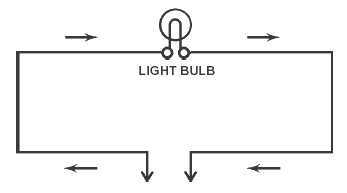
A circuit is a complete path by which electricity can flow. Continuity testing is a means of testing a circuit for electrical closure ie. a complete path.
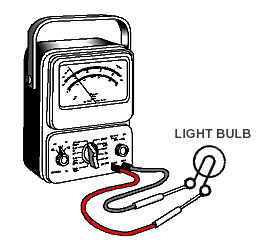
The illustration above is an example of a complete circuit. It is called a complete or closed circuit because the electricity can flow all the way from one end to the other without interruption.
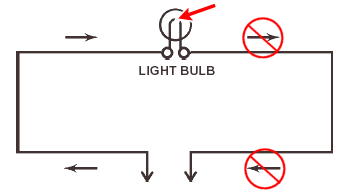
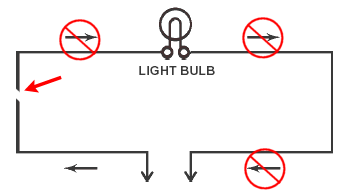
When there is a break in the circuit, we say that the circuit is OPEN. An OPEN circuit is one that cannot operate because there is a break in the path through which the power might flow.
An open circuit will show no continuity or infinite resistance. A closed circuit should show continuity and have some or no resistance. No resistance simply means current can flow through it totally unimpeded.
Sometimes a break is caused by component failure itself while other times the connecting wiring is the source of the open circuit. This is why the component itself should be tested and not just the circuit it may be connected to. To do this at least one wire of the connecting circuit should be removed from the component and terminals directly on the component be used for its testing.
When testing a component while still attached to the rest of the circuit, a test at the component's terminals may also read the resistance of the rest of the circuit instead of the component itself. This is one more reason at least one of the connecting wires must be removed from the component to isolate it from the rest of the circuit.
To test a component for continuity the appliance should first be disconnect from power. After the appliance has been made safe to work on, the component needs to be isolated from the rest of the circuit by removing at least one of the connecting wires. Once that is done, an ohm meter or continuity tester's leads can be held against each terminal of the object to be tested.
If an ohm meter set on the Rx1 scale reads 0 or some resistance or a continuity tester shows continuity, the component is likely good, at least it is not burnt out. If an ohm meter reads infinite resistance or a continuity tester shows NO continuity, the component may be defective.
With digital multi-meters, "Ok" may be displayed when set to continuity testing. Be aware though that if testing something for a particular resistance (like 1100 ohms which most common oven temperature sensors should be), Ok on a digital meter could mean shorted (zero resistance) which would actually mean the part was defective and not "OK". The meter would have to be set for testing resistance (Rx1, Rx100, etc.) to get meaningful resistance measurements if needed.
Personally I'd prefer using a cheap $10 analog VOM meter over any digital meter I've seen. Most appliance repairs do not require the absolute accuracy of measurements a digital meter can display anyway.
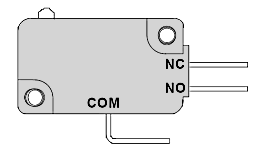
When testing a component with multiple terminals like the micro-switch illustrated below, it will be necessary to determine what readings should be present on each terminal pair. Some switches may indicate their contact's operation by markings right on the switch as illustrated below. Other switches' functioning will need to be determined using the appliance's wiring diagram.
A terminal marked "com" is a common terminal and will make contact with some or all of the other terminals of the component. A terminal marked "NC" indicates a normally closed contact which when tested against the mating common terminal should show continuity when the switch is static and not being actuated. A normally closed contact should open when the switch is actuated.
A terminal marked "NO" indicates a normally open contact which when tested against the mating common terminal should show no continuity when the switch is not being actuated. When actuated a switch's NO contact should close giving a positive continuity reading between it and the common terminal.
Always make note of which wire goes where before removing them to ensure they can be reinstalled properly afterward!




 With digital multi-meters, "Ok" may be displayed when set to continuity testing. Be aware though that if testing something for a particular resistance (like 1100 ohms which most common oven temperature sensors should be), Ok on a digital meter could mean shorted (zero resistance) which would actually mean the part was defective and not "OK". The meter would have to be set for testing resistance (Rx1, Rx100, etc.) to get meaningful resistance measurements if needed.
 Personally I'd prefer using a cheap $10 analog VOM meter over any digital meter I've seen. Most appliance repairs do not require the absolute accuracy of measurements a digital meter can display anyway.